A Saudi government entity starts with AI in four steps: it reads SDAIA's national references, sets up an AI office or unit with a named person accountable, measures its readiness, and then chooses the first three use cases to take into operations. The four steps follow the path set out in the draft AI First Policy: assess readiness, pilot and test feasibility, scale gradually, then follow up and measure impact[4].
Many government entities have taken the first step. SDAIA announced in December 2024 that 23 government entities had set up AI offices[1]. Our guide brings the national references together in one place and gives each step an output the entity can measure. Your legal and regulatory team reviews the obligations specific to your entity before you apply it.
The national references: the Adoption Framework, the National AI Index and the National AI Risk Management Framework
SDAIA has issued three references that every government entity starting with AI needs.
| Reference | Status and date | Its role for a government entity |
|---|---|---|
| AI Adoption Framework | A guiding document SDAIA issued in September 2024[1] | Sets out the first stages: setting direction and priorities, setting up an AI unit, then assessing maturity and readiness. It describes four maturity levels: Emerging, Developing, Proficient and Advanced[1]. |
| National AI Index | An index SDAIA launched in July 2025[2] | Measures how mature government entities are in applying AI and how ready they are to adopt it, across three main pillars, seven main axes and 23 sub-fields[2]. |
| National AI Risk Management Framework | A guiding reference SDAIA launched in July 2026[3] | Sets one method to identify, assess, treat and monitor AI risks in four phases, starting with context and scope. It rates each risk on a matrix of likelihood and impact[3]. |
The three references work together: the Adoption Framework sets the path, the National AI Index measures progress, and the risk framework governs the systems that affect people and data. The risk framework includes a worked scenario of a government entity using a model to prepare internal reports[3]. Our explainer of SDAIA's AI Adoption Framework covers its pillars and components in detail.
The AI First Policy and what it means for a government entity's plan
SDAIA published the draft AI First Policy for public comment on the Istitlaa platform; the page was last updated on 24 June 2026[4]. The draft applies to public entities, recommends that state-owned companies and the private sector make use of it, and describes itself as a directive document[4].
The draft sets three priority areas: business planning and workforce organisation, service design and process development, and procurement and contract planning[4]. Where an entity hands some work to AI solutions, the draft keeps review and approval with a person[4].
The draft gives an entity's plan three tasks: tie each use case to clear institutional value, measure its impact with indicators such as the number of use cases and the impact on the service, the operation or the beneficiary, and track progress through the National AI Index[4]. The draft can change before it is adopted, so plan on its direction and check the final text when SDAIA issues it.
The AI office: its role and the person accountable
The Adoption Framework makes setting up an AI unit the second of its first stages, after setting direction and priorities[1]. The draft AI First Policy asks each entity to have an administrative unit for AI that handles internal follow-up, coordinates with SDAIA and follows up the policy's application regularly[4]. We suggest the office starts small, with clear tasks:
- A named person accountable, who reports to the entity's decision-makers.
- An inventory of AI systems in use and planned, each with a risk class and a person accountable for it.
- An AI policy, with clear decision rights between the office and the departments.
- A value ledger that compares each use case with its baseline, which the office presents to decision-makers every quarter.
- Coordination with the cybersecurity and data management teams from the first day.
Measuring readiness in four weeks
The Adoption Framework puts the maturity and readiness assessment among its first stages, to measure how ready the entity is to adopt AI solutions and to find the areas that need development[1]. In the 4-week diagnostic, we measure readiness on four axes:
- Data: where it sits, its format, the person accountable for it and its classification.
- Systems and infrastructure: the systems the solutions will run inside, and the hosting options in the Kingdom.
- People: the skills in place, the roles that will change, and the training needs.
- Governance: the person accountable, the policy, the system inventory and the risk classes.
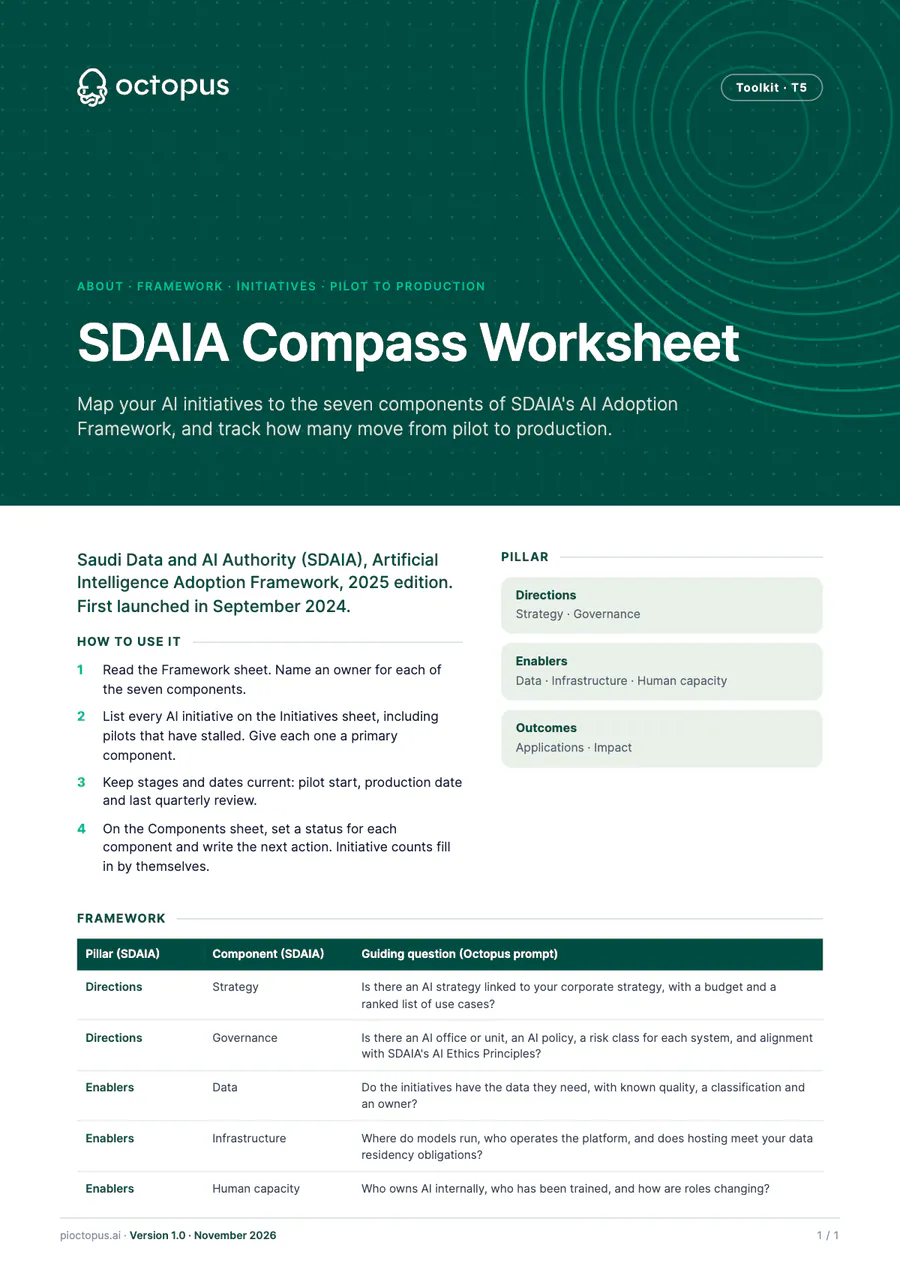
The diagnostic ends with a ranked list of opportunities and a roadmap with decision gates, which the office presents to decision-makers. Your team can run a first pass with the Pilot-to-Live Gap Scan, and map its initiatives to the seven components of SDAIA's framework in the SDAIA Compass Worksheet.
Choosing the first three use cases
Choose the first three use cases with four questions: value, data, fit and risk. The first cases usually sit in high-volume work, inside an existing system, with a person who reviews the result: answering enquiries, classifying correspondence, finding internal knowledge and preparing drafts.
Start with low-risk cases that keep a person in the loop, in line with the draft AI First Policy, which keeps review and approval with people[4]. Record a baseline and a kill criterion for each case before the build, then track its move from pilot to production. Our article on where to start with AI explains the ranking, and our guide to measuring AI ROI in Saudi Arabia explains the business case.
Executive briefing and team training
The draft AI First Policy puts people at the centre of the change. It asks entities to raise staff awareness and enable them, build skills, and manage the effect of AI on roles by redistributing them or reskilling the people in them[4].
With government entities, we start with the executive briefing, where decision-makers learn to question an AI proposal, read its risk and judge its return. Team training by role follows close to go-live, on the system the teams will use and with real cases, and then the AI champions programme for the people who lead adoption inside each department.
How Octopus helps
Octopus works with government and semi-government entities from Riyadh and Al Khobar. We set up the AI office and its governance, measure readiness in the 4-week diagnostic, train decision-makers and teams, and lead the first systems until they run in operations.
Questions and answers
Is SDAIA's AI Adoption Framework binding on government entities?
SDAIA describes the AI Adoption Framework as a guiding document that sets out a full framework for adopting AI across government and private sectors[1]. The draft AI First Policy describes itself as a directive document and asks public entities to take it into account when they develop their services and operations[4]. Check the obligations already in force on your entity, such as the PDPL, with your legal team.
How does SDAIA measure government entities' AI readiness?
Through the National AI Index, which SDAIA launched in July 2025 to measure how mature government entities are in applying AI and how ready they are to adopt it. The index rests on three main pillars, seven main axes and 23 sub-fields[2]. The draft AI First Policy uses the same index to track progress at national level[4].
Does a government entity need an AI office?
Yes, in most cases. The AI Adoption Framework makes setting up an AI unit one of its first stages[1], and the draft AI First Policy calls for an administrative unit for AI that handles internal follow-up and coordination with SDAIA[4]. SDAIA announced in December 2024 that 23 government entities had set up AI offices[1].
Related pages
Sources (4)
Figures are quoted as published. Forecasts and drafts are labelled.
- 1Saudi Press Agency, SDAIA issues the AI Adoption Framework document, 1 December 2024 (Arabic)
- 2Arab News, SDAIA launches the National AI Index for government entities, 23 July 2025
- 3Saudi Press Agency, SDAIA launches the National AI Risk Management Framework as a guiding reference for government and private entities, 14 July 2026 (Arabic)
- 4SDAIA on the Istitlaa platform, draft AI First Policy, last updated 24 June 2026 (Arabic; the policy is a draft)