To measure the ROI of an AI project in Saudi Arabia, record a baseline before the build, track two or three KPIs that finance already reports, and count the full cost: build, run, change and compliance. Once the system is live, compare realised value with the baseline every month, and review it with finance every quarter until finance signs it off.
Few organisations can show the return on their AI today. In McKinsey's November 2025 survey of GCC organisations, 84 of every 100 use AI, and only 11 see a clear impact on profit, 5% or more of earnings[1]. Globally, IBM's 2025 study of 2,000 CEOs found that only 25% of AI initiatives had delivered the expected return over the past few years[2]. In Gartner's 2024 survey, 49% of respondents named the difficulty of estimating and demonstrating value as the main barrier to AI adoption[3].
National policy points the same way. SDAIA's draft AI First Policy for public entities puts value before technology: an entity adopts AI where it proves suitable and feasible against other options, and measures its impact continuously, with indicators such as the number of use cases and the impact on the service, the operation or the beneficiary[4]. SDAIA published the draft for public comment on the Istitlaa platform[4].
Set the baseline before the build
The baseline is the figure you measure against: hours per case, cycle time, error or rework rate, or cost per transaction. Record it before the build starts, from the system of record or from a timed walk-through of real cases. A baseline set after go-live is hard to check, because the old process has already changed.
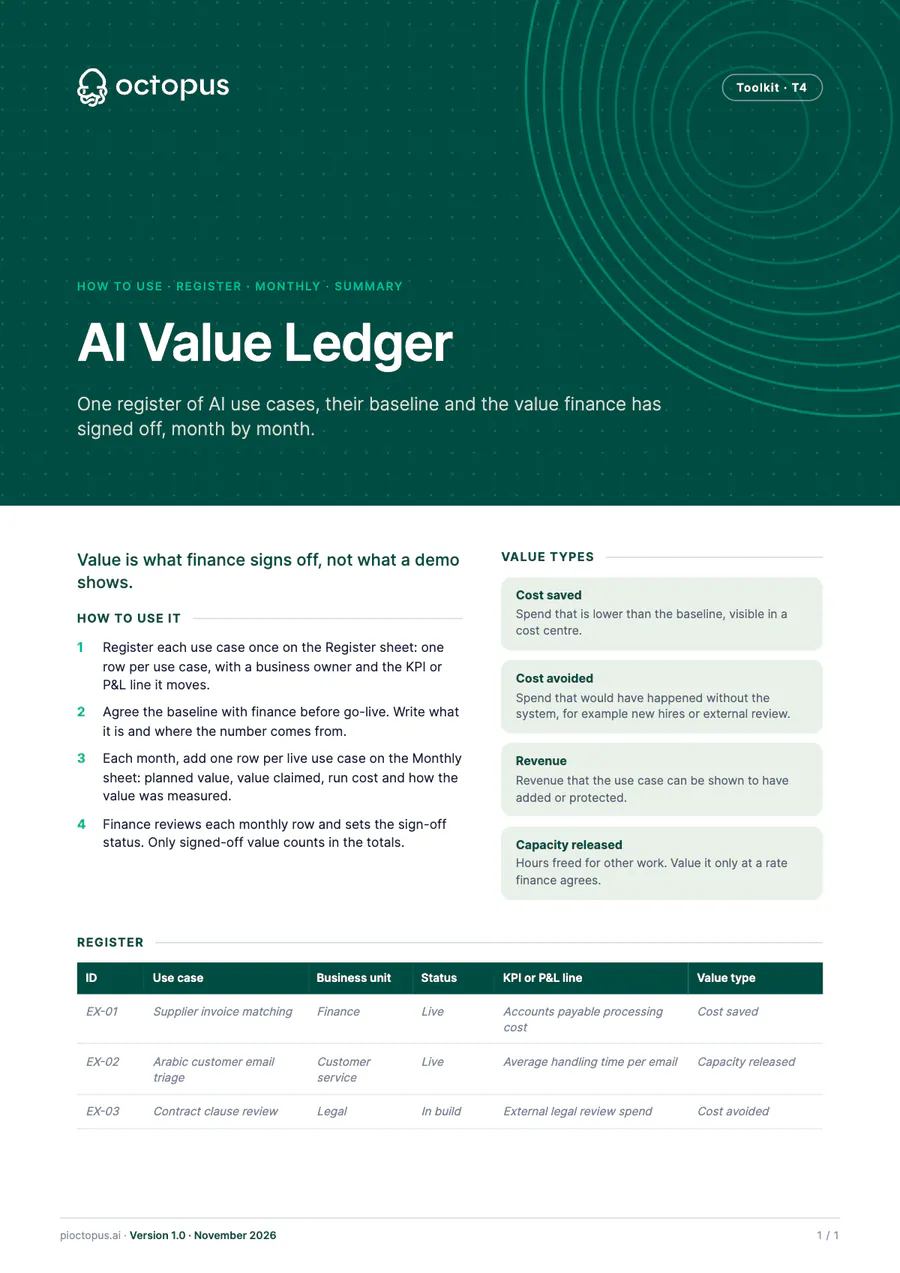
Agree three things with the team that runs the process: the figure, how it is measured, and who reports it. Write them into the business case. The AI Value Ledger in our toolkit gives each use case one row, with its baseline, its target and the person accountable for it.
AI ROI KPIs: the numbers finance already tracks
Choose KPIs that already appear in a finance or operations report, so everyone trusts them from the start. Most AI value falls into four groups.
- Time: hours per case, cycle time from request to decision, time to first response.
- Cost: cost per transaction, overtime, outsourced volume, the cost of rework.
- Quality: error rate, rework rate, complaints, cases referred to a person.
- Service and revenue: customer or beneficiary satisfaction, completed digital transactions, conversion or collection rates.
Add one usage measure next to the value measures: the share of eligible cases that go through the new system. Value follows use, and a system that half the team avoids returns half its value. Two or three KPIs per use case are enough for the board.
Count the full cost: build, run, change and compliance
A business case that counts only licences and the build overstates the return. Count four kinds of cost over at least three years.
| Cost | Items |
|---|---|
| Build | Design, integration with existing systems, data preparation, testing on real cases, and Arabic test material. |
| Run | Model and platform fees, hosting, monitoring, support, and re-testing as the data changes. |
| Change | Process redesign, training by role, the team's time to learn the new way, and running the old and new paths side by side for a period. |
| Compliance | Data classification, review of personal data under the PDPL, cybersecurity controls, records for audit, and the governance work for each system. |
In Saudi Arabia, hosting and data rules can change the cost to run. The Personal Data Protection Law has been in force since 14 September 2023[5] and sets conditions for transferring personal data outside the Kingdom. If the model or the platform has to run inside the Kingdom, price that option into the business case from the start. Our guide to AI governance in Saudi Arabia sets out the data and hosting rules.
Build the AI business case in five steps
- Name the process and the person accountable for it, with its monthly volume and the hours it takes today.
- Record the baseline and set a target for two or three KPIs, in figures finance already uses.
- Estimate the full cost over three years: build, run, change and compliance.
- Set the gates and the kill criteria: the date of each decision, and the result that stops the project or changes its course.
- Agree with finance how value will be reported, and who signs it off.
Keep the business case to one or two pages. A short case that finance has checked carries more weight with the board than a long one with optimistic figures. Ranking use cases before you build the cases helps too: our article on where to start with AI scores each idea on value, data, fit and risk.
Report value monthly, review it with finance every quarter
Once the system is live, compare realised value with the baseline every month, next to the value the business case first claimed. Keep the business case's first figure unchanged. The gap between that first figure and the realised value is what you review with finance every quarter.
SDAIA's AI Adoption Framework also asks entities to measure the return on each AI initiative and to review their initiatives every quarter, as our explainer of the framework sets out.
Value that keeps falling short of the target is a useful result as well. Change the use case or stop it, and move the budget to the next use case in the ranking.
A baseline recorded before the build is evidence. A baseline recorded after it is a guess.
Who can help build an AI business case in Saudi Arabia
Your finance team is accountable for the numbers and signs off the value. An outside team helps when use cases need ranking across departments, when the baseline needs measuring in the field, or when the board wants a case it can defend. Octopus ranks use cases and builds business cases from Riyadh and Al Khobar, in Arabic and English. Executives who will judge the cases can start with our executive AI training.
How Octopus helps
The 4-week diagnostic ranks your AI opportunities by value and hands you business cases for the top ones, with a roadmap. Once a system is live, we track its value in the AI Value Ledger: reported monthly, reviewed with finance every quarter.
Questions and answers
Which KPIs prove AI value to a board?
Two or three per use case, taken from reports finance already trusts: hours or cost per case, cycle time, error or rework rate, and customer or beneficiary satisfaction. Add the share of eligible cases that go through the new system. Report each one against the baseline recorded before the build.
Do Saudi rules change the AI business case?
Yes, mostly through cost. The PDPL has been in force since 14 September 2023[5] and sets conditions for personal data that leaves the Kingdom, and your data classification may call for hosting inside the Kingdom. Price the hosting option, the PDPL review and the security controls into the case from the start. For public entities, SDAIA's draft AI First Policy asks for feasibility against other options and continuous measurement of impact[4].
When should we stop an AI project?
When it misses the kill criterion set before the build: for example, the KPI has stayed at the baseline by the agreed gate, use stays low after training, or the cost to run exceeds the value it returns. Write the kill criteria into the business case, so stopping is a planned decision. Then move the budget to the next use case in the ranking.
Related pages
Sources (5)
Figures are quoted as published. Forecasts and drafts are labelled.
- 1McKinsey and GCC Board Directors Institute, The state of AI in GCC countries: In pursuit of scale and value, November 2025 (survey of 139 senior executives and board members)
- 2IBM, CEO study press release, 6 May 2025 (2,000 CEOs in 33 countries)
- 3Gartner, survey press release, 7 May 2024
- 4SDAIA on the Istitlaa platform, draft AI First Policy, last updated 24 June 2026 (Arabic; the policy is a draft)
- 5Saudi Press Agency, SDAIA announces the PDPL in force, 14 September 2023 (Arabic)