SDAIA's National AI Index (NAII) measures how ready a Saudi government entity is to adopt AI. It scores the entity on three pillars (Directions, Enablers and Outputs), seven sub-pillars and 23 domains, and places it on one of six maturity levels, from Absence of Capabilities to Pioneer. Every answer needs supporting documents, so preparing for the index means building the evidence before the measurement cycle opens[1].
The Saudi Data and AI Authority (SDAIA) launched the index in July 2025. More than 180 representatives of government entities took part in the first measurement cycle, according to the Saudi Press Agency[3]. SDAIA's methodology document, version 1 of May 2025, sets out the structure, the levels and the measurement steps[1]. The OECD's AI policy database lists the index and reports a first phase with 30 government entities[2]. This guide works from SDAIA's document. It is a practical guide to start from; your AI office checks each point against SDAIA's current questionnaire.
What the National AI Index measures
The index assesses how ready government entities are to adopt AI, monitors their progress periodically, and gives each entity practical recommendations on its strengths and the areas to improve[1]. SDAIA states three objectives: aligning government efforts and priorities in AI, providing and improving the enablers of adoption, and enabling AI products in key sectors while making sure their impact is realised[1].
The index is built for government entities[1,3]. Companies work with SDAIA's AI Adoption Framework, which covers government and private entities alike and is organised around the same seven areas: strategy, governance, data, infrastructure, human capacity, applications and impact[4]. Semi-government entities and state-owned companies that work closely with government can use the index structure as a self-check.
The three pillars of the National AI Index: Directions, Enablers and Outputs
Each pillar holds two or three sub-pillars, and every sub-pillar holds three or four of SDAIA's 23 domains. Together they cover strategic, regulatory, technical, operational and human aspects[1].
| Pillar | Sub-pillar | Domains |
|---|---|---|
| Directions | Strategy | Planning and performance; initiatives; budget |
| Directions | Governance | Frameworks and policies; regulatory enablement; reliability and safety; regulatory compliance |
| Enablers | Data | Availability and accessibility; quality and integration; reliability |
| Enablers | Infrastructure | Technical standards; availability and monitoring; operational resilience |
| Enablers | Human capabilities | Headcount and diversity; professional development; academic collaboration; job stability |
| Outputs | Applications | Development and deployment; privacy and security; operation and management |
| Outputs | Impact | Operational efficiency; employee productivity; service quality and improvement |
Several domains name specific expectations. Regulatory enablement asks for an AI unit inside the entity, with clear mandates. Regulatory compliance names SDAIA's own frameworks, such as the Generative AI Guidelines and the Deepfakes Guidelines. Privacy and security asks for security and privacy by design and compliance with the Personal Data Protection Law. Operation and management links model use to enterprise indicators such as service quality and cost reduction, with reports to senior management. Impact is measured with return on investment models[1].
The six maturity levels of the National AI Index
The index turns the answers into an adoption score and places the entity on one of six levels[1].
| Level | Score | What it describes |
|---|---|---|
| 0. Absence of Capabilities | 0 to 4.9% | AI is not yet established in the organisation. |
| 1. Establishing | 5 to 24.9% | Limited initiatives or pilots, without a clear organisational structure. |
| 2. Activated | 25 to 49.9% | Frameworks, strategy and AI governance are in place, and implementation starts in several departments. |
| 3. Managed | 50 to 79.9% | AI is part of operations and decisions, guided by performance indicators and governance. |
| 4. Excellence | 80 to 94.9% | AI drives strategic transformation and delivers tangible impact, with initiatives evaluated periodically. |
| 5. Pioneer | 95 to 100% | The organisation leads the national landscape, with continuous innovation and measurable impact. |
The score aggregates the results of the domains with predetermined weights. The methodology document gives the method and leaves the weights out[1], so plan on improving all 23, with the most effort where your evidence is thinnest.
How SDAIA runs a measurement cycle
- Awareness workshops. SDAIA explains the index, its objectives and the questions to representatives of each entity, and how to compile and share the supporting documents.
- Questionnaire and supporting documents. The entity answers the questions and shares the documents and evidence behind each answer.
- Review and verification. A specialised team checks the answers and the documents, and holds follow-up workshops where points need clarifying.
- Results. The entity receives its adoption score and a detailed report with targeted recommendations, and SDAIA publishes a comprehensive national report for the government sector.
SDAIA reviews the index components, the questions and the method every year[1]. Read the current questionnaire at the start of each cycle, and update your evidence folder to match.
How to prepare for the National AI Index
- Name a person accountable for the index response, usually in the AI office, and one contact for each of the seven sub-pillars.
- Score yourself against the 23 domains before the cycle opens, and write down the document that proves each answer.
- Build the evidence folder now, sub-pillar by sub-pillar, with the documents in the table below.
- Close the gaps that move the score most: an approved AI strategy with a budget, an AI unit with a mandate, an inventory of AI systems with a risk class for each, and impact measured against a baseline.
- Tag every AI initiative to the domains it moves, so the evidence for the next cycle builds up as the work runs.
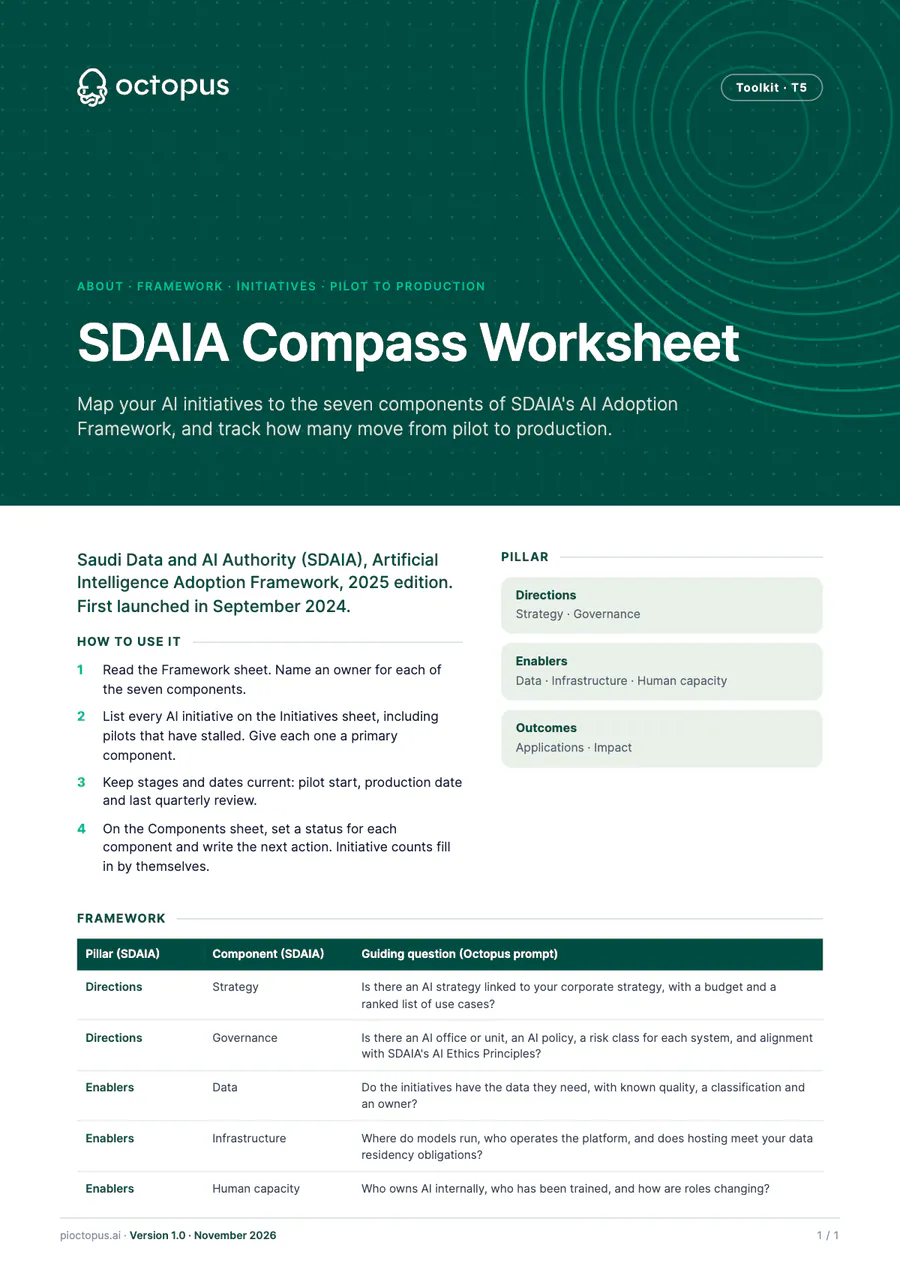
The SDAIA Compass Worksheet in our toolkit sets this up in one file: the seven components, a person accountable for each, and your initiatives tagged to them. Impact is the sub-pillar where many entities hold the least evidence. Our guide to measuring the ROI of AI projects sets out the baseline and the KPIs that give you that evidence.
What evidence to keep for each sub-pillar
| Sub-pillar | Evidence to keep |
|---|---|
| Strategy | The approved AI strategy, linked to national priorities and Vision 2030; the list of AI initiatives with a person accountable and a status for each; the approved AI budget. |
| Governance | The AI policy and governance framework; the decision that set up the AI unit and its mandate; the inventory of AI systems with risk classes; records of how you apply SDAIA's AI Ethics Principles[5], the Generative AI Guidelines and the Deepfakes Guidelines. |
| Data | The data catalogue; data quality reports; records of data sources, usage rights and legal reviews; the backup and disaster recovery plan. |
| Infrastructure | Architecture documents; capacity and monitoring reports; availability and incident records; integrations with national platforms. |
| Human capabilities | AI roles mapped to the National Occupational Standard Framework for Data and AI; the training plan and attendance records; university partnerships; attrition analysis and retention measures. |
| Applications | The list of AI applications in operation; model lifecycle records; privacy and security by design reviews and PDPL records; usage and performance reports to senior management. |
| Impact | The baseline and measured results for efficiency, productivity and service quality; the return on investment calculation for each initiative. |
The National AI Index and SDAIA's AI Adoption Framework
SDAIA's AI Adoption Framework guides adoption through three pillars and seven components[4], and the index measures the same seven areas in government entities[1]. The 2025 edition of the framework said SDAIA was developing a maturity index for AI adoption in government entities[4]. Work organised around the framework therefore builds the evidence the index asks for. Our explainer of SDAIA's AI Adoption Framework covers its pillars and components in detail.
SDAIA's draft AI First Policy for public entities would also use the National AI Index to track progress at national level[6]. The policy is a draft, and its final text may change.
How Octopus helps
We help government and semi-government entities prepare for the National AI Index: a self-assessment on the 23 domains, an evidence folder per sub-pillar, and a 90-day plan for the gaps that move the score most. The work runs through our AI governance and regulatory readiness review, a fixed scope over 3 to 4 weeks. Octopus references SDAIA's index and is not affiliated with SDAIA.
Questions and answers
Does the National AI Index apply to private companies?
SDAIA built the index for government entities[1]. Companies work with SDAIA's AI Adoption Framework, which covers government and private entities and uses the same seven areas as the index[4]. State-owned companies that work closely with government can use the index structure as a self-check.
What are the pillars of the National AI Index?
Three pillars: Directions (strategy and governance), Enablers (data, infrastructure and human capabilities) and Outputs (applications and impact). Under them sit seven sub-pillars and 23 domains[1].
How many maturity levels does the index have?
Six: Absence of Capabilities, Establishing, Activated, Managed, Excellence and Pioneer, numbered 0 to 5. Each level has a score range, from 0 to 4.9% for level 0 to 95 to 100% for Pioneer[1].
What evidence does SDAIA ask for?
Each answer in the questionnaire needs supporting documents and evidence, and a specialised team reviews and verifies them[1]. Keep one folder per sub-pillar: the approved strategy and budget, the AI policy and the decision that set up the AI unit, the inventory of AI systems, data and infrastructure records, training records, and measured impact against a baseline.
How often is the index measured?
The index monitors progress periodically, and SDAIA reviews its components, questions and method every year[1]. The first measurement cycle started in July 2025[3].
Related pages
Sources (6)
Figures are quoted as published. Forecasts and drafts are labelled.
- 1SDAIA, National AI Index (NAII), methodology document, version 1, May 2025 (SDAIA-P123), copy published on the OECD.AI Policy Navigator: objectives p. 5, pillars, sub-pillars and domains pp. 7 to 14, maturity levels pp. 15 to 17, measurement and results pp. 18 to 21
- 2OECD.AI Policy Navigator, National AI Index (NAII), Saudi Arabia
- 3Arab News, SDAIA launches the National AI Index for government entities, 23 July 2025 (citing the Saudi Press Agency)
- 4SDAIA, Artificial Intelligence Adoption Framework, version 2, May 2025 (SDAIA-P121): pillars and components pp. 8 to 9; maturity index p. 42
- 5SDAIA, AI Ethics Principles
- 6SDAIA on the Istitlaa platform, draft AI First Policy, last updated 24 June 2026 (Arabic; the policy is a draft)