SDAIA's AI Adoption Framework is the Saudi Data and AI Authority's published guide to adopting AI in government and private entities. SDAIA launched it in September 2024 and issued version 2 in May 2025. It sets out three pillars and seven components, from strategy to measured impact, as guiding principles rather than detailed technical standards[1,2].
Search results disagree about this framework. Some summaries call it mandatory, others call it non-binding, and few link to the document itself. This explainer works from SDAIA's own PDF and announcements, and labels every draft as a draft. It is a practical guide to start from; your legal and security teams sign off.
What the framework is, and who issued it
The Saudi Data and AI Authority (SDAIA) unveiled the framework at the third Global AI Summit in Riyadh in September 2024[2]. In December 2024 SDAIA shared the document publicly and said it aims to promote the responsible use of AI while supporting innovation across sectors[3]. The current edition on SDAIA's website is version 2, dated May 2025[1].
The framework covers all government and private entities, whatever their sector or level of digital maturity. The 2025 edition names two primary audiences: government entities, and policymakers and legislators[1]. It focuses on applied AI, such as predictive systems, natural language processing, image and video analysis and intelligent automation, and leaves out theoretical research[1].
Is the AI Adoption Framework binding?
The 2025 edition calls itself a comprehensive guidance framework and a practical guide. It says it provides guiding principles and enablers, not detailed technical standards, and it writes its steps as recommendations[1]. SDAIA's 2024 announcement also called it a guiding reference[2]. SDAIA files the document under the type Regulatory Documents (SDAIA-P121, version 2)[1], so if you need a firm answer for your entity, ask your legal team.
The framework does point to obligations that come from other rules: it says entities are obliged to implement the Personal Data Protection Law and its Implementing Regulations[1]. Binding rules written for AI are a separate matter. SDAIA's Responsible AI Policy would introduce them, with compliance obligations and supervisory powers for SDAIA[9]. The Responsible AI Policy is still a draft; its public consultation ran from April to May 2026[8].
Three pillars and seven components
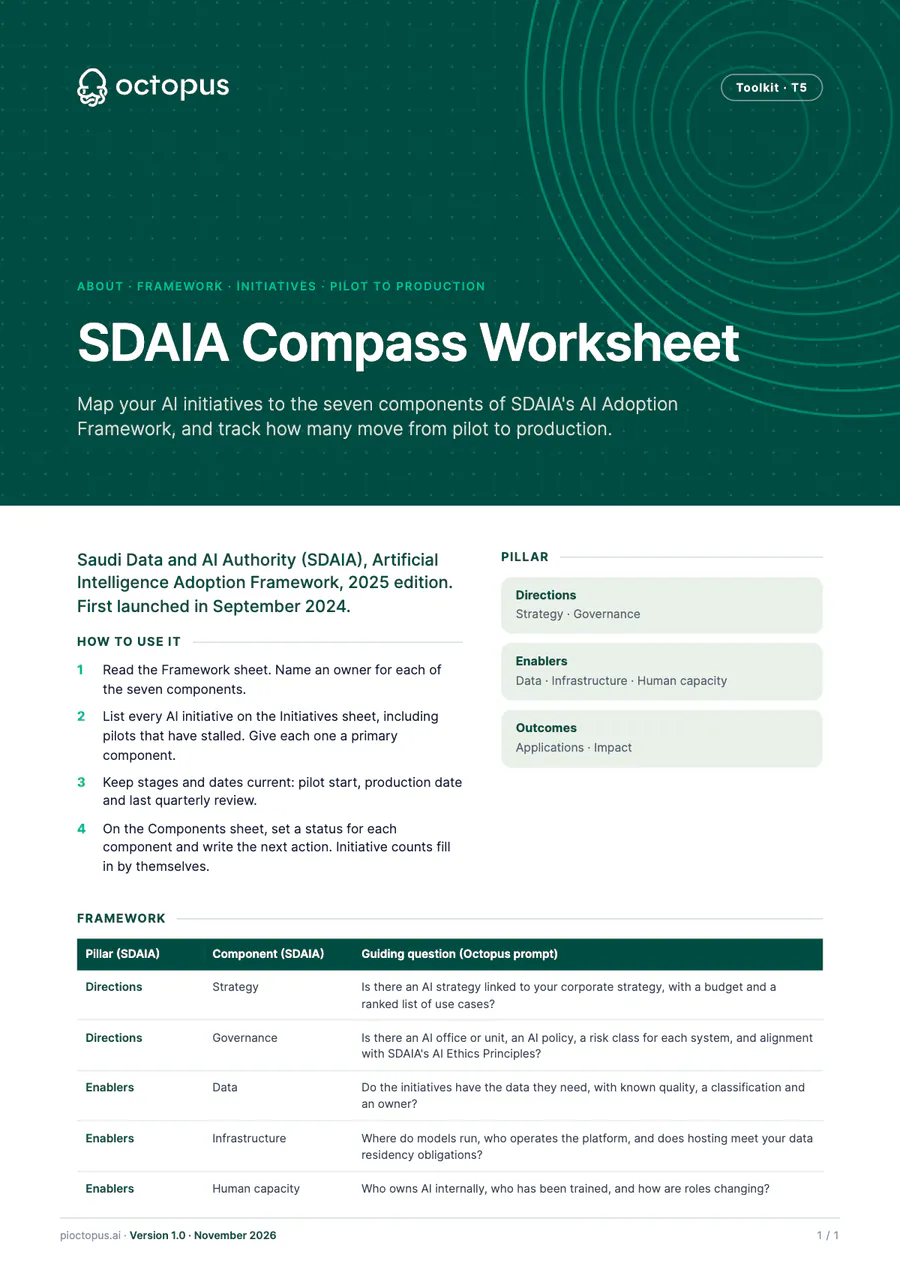
Version 2 of the framework organises AI adoption into three pillars, each with its own components[1].
| Pillar | Components | What it covers |
|---|---|---|
| Directions | Strategy, Governance | The strategic and organisational side: a clear vision and goals, well-designed initiatives, and governance frameworks that are followed. In practice: an AI strategy linked to Vision 2030 and the National Strategy for Data and AI, an AI office, and alignment with SDAIA's AI Ethics Principles. |
| Enablers | Data, Infrastructure, Human capacity | What AI runs on: a workforce of the right size and skills, data that is available, of good quality and reliable, and technical systems that are robust and adaptable. |
| Outcomes | Applications, Impact | What AI delivers: models developed and deployed efficiently, with monitoring, security and technical governance, and impact on performance such as lower costs, better service quality and more sustainable use of resources. |
The framework's diagram lists 23 sub-elements under the seven components. Examples include budget and regulatory compliance under the Directions pillar, quality and integration under data, and service quality enhancement under impact[1].
Directions
Strategy
- Plan and performance
- Initiatives
- Budget
Governance
- Frameworks and policies
- Organisational empowerment
- Trustworthiness and safety
- Regulatory compliance
Enablers
Data
- Availability and access
- Quality and integration
- Reliability
Infrastructure
- Technical standards
- Availability and follow-up
- Operational flexibility
Human capacity
- Number and diversity
- Professional development
- Academic cooperation
- Job stability
Outcomes
Applications
- Development and deployment
- Privacy and safety
- Operation and management
Impact
- Operational efficiency
- Employee productivity
- Service quality enhancement
The measures it names
The framework lists KPIs for AI adoption, including tracking how projects move from pilot to production, which it describes as a possible indicator of enterprise maturity. It also asks for return on investment to be measured, for each AI initiative to be reviewed every quarter, and for each initiative to carry its own measurable outputs, such as work hours saved, beneficiary satisfaction or model accuracy[1].
Its time horizons
- Short term, one to two years: quick wins from automating routine processes and using predictive analytics to support decisions[1].
- Medium term, three to five years: more advanced applications such as smart products and services, with investment in skills, digital infrastructure and innovation teams[1].
- Long term, more than five years: intelligent systems capable of self-learning and adaptation, backed by research and development and strategic partnerships[1].
Maturity levels: the 2024 edition
The September 2024 edition set four maturity levels[4]:
- Emerging
- Developing
- Proficient
- Advanced
The 2025 edition does not carry this scale. It says SDAIA, through the National Center for AI, is developing a maturity index for AI adoption in government entities[1]. When you score yourself against the four levels, say that they come from the 2024 edition.
What it asks of a government entity, and of a company
The framework covers government and private entities alike[1]. The documents around it treat the two differently.
| Government entity | Company | |
|---|---|---|
| Organisation | An AI office or unit with a strategy linked to national priorities[1]. SDAIA's December 2024 announcement said 23 government entities had set up AI offices[2]. | The same structure is recommended: a named person accountable, an AI unit and a strategy[1]. |
| Measurement | SDAIA's National AI Index assesses government entities' readiness to adopt AI[10], and the framework says SDAIA is developing a maturity index for government entities[1]. | The National AI Index is built for government entities[10]. Companies measure themselves against the framework's KPIs[1]. |
| Draft Responsible AI Policy | Public entities would lead compliance through their AI office: an inventory of AI systems, a risk class for each, and human oversight[9]. Draft. | Private and non-profit entities would also be in scope. The first stage of mandatory compliance would cover high-risk sectors and large companies, as determined by SDAIA[9]. Draft. |
| Draft AI-First Policy | Would apply to public sector entities and make AI the preferred option where it is shown to be suitable and to deliver measurable value[9]. Draft. | State-owned and private companies are encouraged to apply its principles where appropriate[9]. Draft. |
Both kinds of entity are already bound by rules that are not about AI alone, such as the Personal Data Protection Law and, within their scope, NCA's cybersecurity controls. We cover what each asks of an AI project in PDPL, NCA and SDAIA: what they ask of AI. For a step-by-step start in a government entity, read how a Saudi government entity starts with AI.
How it fits with SDAIA's other AI documents
| Document | Status | Role |
|---|---|---|
| AI Ethics Principles | Published, first edition, September 2023[5] | Seven principles and four risk tiers for anyone who designs, develops, deploys or uses AI in the Kingdom. The adoption framework asks entities to align with them[1,5]. |
| Generative AI Guidelines | Published, first editions, January 2024[6,7] | Two editions, one for government staff and one for the public, on using generative AI tools safely. |
| AI Adoption Framework | Published 2024; version 2, May 2025[1,2] | Guidance for adoption, from strategy to impact. |
| Responsible AI Policy | Draft. Public consultation ran from April to May 2026[8] | Would turn the ethics principles into binding obligations, with four risk tiers, registration, safety reports and audits for high-risk systems[9]. |
| AI-First Policy | Draft, published for public consultation in 2026[9] | Would set AI as the preferred option for public sector services where it is suitable[9]. |
| National AI Index | Launched July 2025[10] | Measures government entities' readiness on three pillars, seven dimensions and 23 subcategories, with six maturity levels[10]. |
How to use the framework in practice
- Name an owner for each of the seven components, even if one person holds several.
- Tag every AI initiative to the components it moves, so the roadmap reports in the framework's own terms.
- Baseline your position. If you use the four maturity levels, label them as the 2024 edition.
- Track how many projects move from pilot to production. The framework names this measure, and it shows quickly whether pilots are turning into operations.
- Keep the drafts on your radar. Prepare an inventory and a risk class for each AI system now, because the draft Responsible AI Policy points to both.
The SDAIA Compass Worksheet sets this up in one file: the seven components, an owner for each, your initiatives tagged to them, and a pilot-to-production count.
This is the work of our practices in AI governance, risk and regulatory readiness and AI strategy, investment and value realisation. Each of our six practices maps to one or more of the seven components, as the frameworks page shows. Octopus references SDAIA's framework and is not affiliated with SDAIA.
Questions and answers
Is SDAIA's AI Adoption Framework mandatory?
The 2025 edition presents itself as a guidance framework and a practical guide, with guiding principles rather than detailed technical standards, and it writes its steps as recommendations[1]. SDAIA's 2024 announcement called it a guiding reference[2]. Binding AI rules would come from the Responsible AI Policy, which is still a draft[8,9].
Who does the AI Adoption Framework apply to?
All government and private entities in the Kingdom, whatever their sector or level of digital maturity. The 2025 edition names two primary audiences: government entities, and policymakers and legislators[1].
What are the framework's pillars and components?
Three pillars and seven components. Directions covers strategy and governance. Enablers covers data, infrastructure and human capacity. Outcomes covers applications and impact[1].
What maturity levels does it use?
The 2024 edition set four levels: Emerging, Developing, Proficient and Advanced[4]. The 2025 edition does not carry this scale; it says SDAIA is developing a maturity index for AI adoption in government entities[1]. Label any self-assessment on the four levels as the 2024 edition.
How is it different from the draft Responsible AI Policy?
The framework guides how to adopt AI. The draft policy would regulate it: four risk tiers with Critical Risk prohibited, registration of AI products, safety reports reviewed by SDAIA before high-risk deployment, and annual third-party audits of high-risk systems[9]. The Responsible AI Policy is still a draft; its public consultation ran from April to May 2026[8].
Related pages
Sources (10)
Figures are quoted as published. Forecasts and drafts are labelled.
- 1SDAIA, Artificial Intelligence Adoption Framework, version 2, May 2025 (SDAIA-P121, English): purpose, audience and scope pp. 4 to 6; pillars, components and 23 sub-elements pp. 8 to 9; KPIs, quarterly reviews and time horizons pp. 15 to 18; ethics and PDPL p. 20; AI office p. 24; maturity index p. 42; edition details p. 48
- 2Saudi Press Agency, SDAIA launches AI framework to promote ethical, responsible use of advanced technologies, December 2024
- 3SDAIA on X, link to the AI Adoption Framework, 1 December 2024
- 4Al-Watan, SDAIA's AI Adoption Framework and its maturity levels, 2 December 2024
- 5SDAIA, AI Ethics Principles, first edition, September 2023
- 6SDAIA, Generative AI Guidelines for Government, first edition, January 2024
- 7SDAIA, Generative AI Guidelines for the Public, first edition, January 2024
- 8Saudi Press Agency, SDAIA invites the public and entities to comment on the draft Responsible AI Policy, April 2026
- 9AS&H Clifford Chance, briefing on SDAIA's draft Responsible AI Policy and draft AI-First Policy, 4 November 2026 (legal briefing; both policies are drafts)
- 10Arab News, SDAIA launches the National AI Index for government entities, 23 July 2025