AI training for teams, by role
One track per role, on your team's own documents and systems. Arabic first.
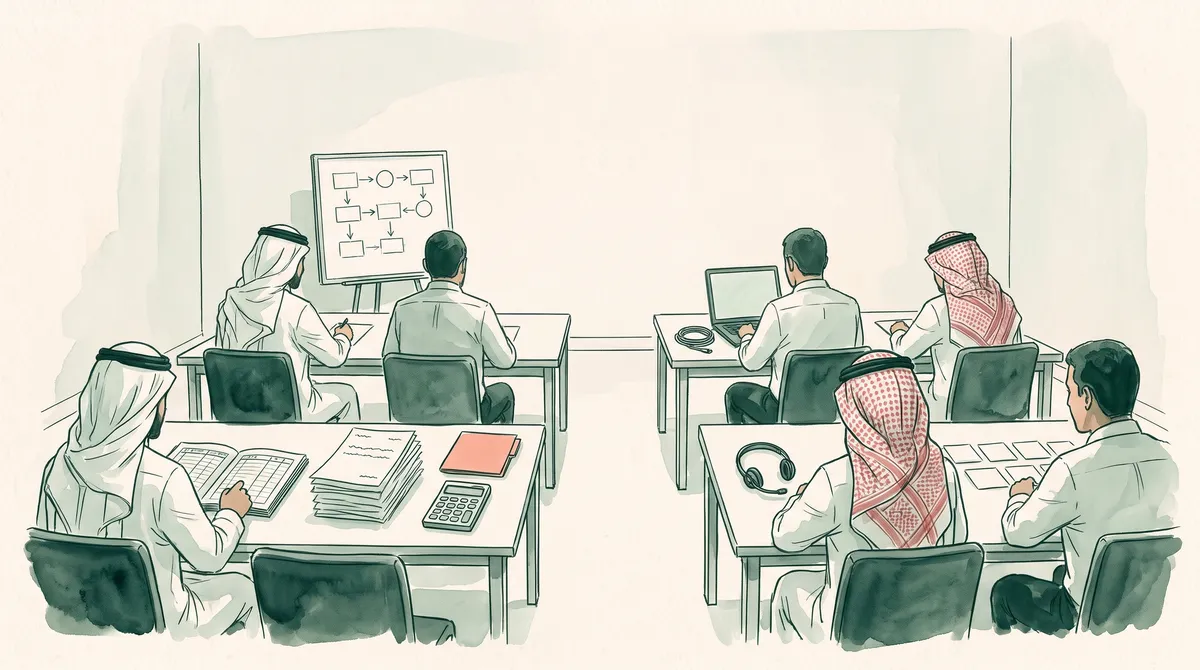
Each team trains on its own work.
An accountant's work is not a customer service agent's work, so their training differs too. We collect each team's real tasks, build the exercises on them, and agree with the team where the limits on data sit for each tool. Then we follow usage after the training.
The question we start with
Which three tasks in your team's work today are worth doing well with AI first?
The challenge
One course for everyone, and no visible effect.
Many organisations give every employee the same course, so each team leaves without a clear task to apply it to.
More context
Arabic documents and internal systems stay out of the exercises.
Exercises unlike the work
Generic examples in English instead of the team's own documents and forms.
Fear of getting it wrong
People avoid the tool when they don't know which data is allowed.
No follow-up
The training ends in the room, and nobody follows usage afterwards.
Tracks
Six tracks, each with its own tasks.
Examples of the tasks we practise in each track. We choose the final tasks with your team.
Operations
Summarising daily reports, drafting work procedures, and following up late requests.
Customer service
Drafting replies in Arabic in your organisation's tone, classing complaints, and summarising long conversations.
Finance
Variance analysis, reviewing invoices and contracts, and drafting management reports.
HR
Writing job descriptions, answering policy questions, and a first pass on CVs with a person reviewing every decision.
Legal and compliance
Reviewing contracts against a clause list, summarising new regulations, and tracking obligations.
IT and data
Writing queries, documenting systems, and assessing tools against the National Cybersecurity Authority controls.
Programmes
Two programmes for teams. A track by role, and short labs.
Team training by role
One track per role, built on your team's own documents and systems.
- Duration
- 2 days per track, or 4 half-day sessions
- Group size
- Up to 20 participants per cohort
- For
- Operations, customer service, finance, HR, legal and compliance, and IT and data teams.
- Outcome
- Each team masters three to five tasks from its daily work with the AI tools your organisation has approved, and knows where the limits are.
Request a training proposalProgramme details
What it covers
- Before the training: we collect real examples from the team's work, with personal data removed.
- Practice: every participant works on their own tasks, not generic examples.
- Limits: which data may go into which tool, and when to check the output before using it.
- After the training: an Arabic prompt library for the team, and a follow-up after 30 days.
You receive
- A prompt library in Arabic and English for each role.
- A one-page guide to the data allowed in each tool.
- A list of use cases the team proposed, ranked by value.
- Pre and post assessment results for each cohort.
Format
On site at the team's office or in Riyadh or Al Khobar, or live online. In Arabic or English.
After the programme
The strongest use cases become workflows we redesign end to end.
Operations and service re-engineering with AITool and Arabic prompting labs
Three hands-on hours: prompting in Arabic, Arabic documents and checking the output.
- Duration
- 3 hours per lab
- Group size
- Up to 25 participants
- For
- Anyone who uses AI tools in their daily work, or soon will.
- Outcome
- Participants write clear prompts in Arabic, handle scanned Arabic documents, and check the output before they rely on it.
Request a training proposalProgramme details
What it covers
- Prompting in Modern Standard Arabic and in dialect, and when the output differs.
- Arabic documents: scanned files, tables and handwriting.
- Checking the output before it goes out: figures, names and sources.
- Limits of use under your organisation's policy and the PDPL.
You receive
- Arabic prompt cards each participant keeps.
- A checklist for reviewing AI output before relying on it.
Format
On site or live online, on the tools your organisation has approved.
After the programme
The lab results show which tool handles your Arabic documents best, which feeds the platform and sourcing decision.
Data, sovereign platforms and technology sourcing
Formats
Where it suits your team, in the language it works in.
On site
At your offices, or at ours in Riyadh and Al Khobar.
Live online
Live sessions with a trainer, not recordings.
Arabic or English
Every programme has an Arabic and an English version, and one cohort can mix both.
Data under your control
We work on examples with personal data removed. Data stays in the Kingdom by default. Any exception needs your written approval.
How we measure
We measure the effect at work, after the room.
Every cohort has a baseline on day one, and we compare against it after 30 days.
Pre and post assessment
A practical task from the team's work, before and after the training.
Use after 30 days
The share of participants using the approved tools in their tasks.
Time on the chosen tasks
We compare how long each task takes against the baseline.
Quality of the output
The team's manager reviews a sample of work before and after the training.
Questions
Questions training leads ask.
Do we train every employee or specific teams?
We usually start with two or three teams that have clear tasks.
More detail
Then we extend the programme based on the results, or your training team takes it to the rest of the organisation.
Do you use our real data in the exercises?
We use real examples with personal data removed.
More detail
Data stays in the Kingdom by default. Any exception needs your written approval.
Is the training in Arabic?
Yes. We deliver every track in Arabic or English.
More detail
We practise on Arabic and scanned documents, because they are a large part of what teams in the Kingdom work with.
Start with two teams, and measure the effect after 30 days.
30 minutes with our team. We tell you plainly where we would start.