In many organisations across the Kingdom, operations still run on paper. Forms, letters and supporting documents move from desk to desk, and are filed and retrieved by hand. Document AI can change that, if it is built around how people actually use the records. This is what it takes on Arabic documents.
More than a faster scanner
The aim is never to digitise for its own sake. An organisation needs an archive it can search and act on. A scanned page is still a picture. A record is something a system can find, check and route.
Two kinds of models work together. Optical character recognition (OCR) extracts the text. Vision-language models (VLMs) read the page as image and text together. That helps with what OCR handles poorly on its own: stamps, tables, signatures, Arabic mixed with English, and layouts that change from one form to the next.
Start from the questions people ask the archive
Before choosing models, list what staff actually look for: a record by a person's name, a document by type, everything related to one case. Those questions decide which fields to extract and how to index them. Reading the right fields reliably is worth more than reading every word on every page.
This also keeps the project honest about scope. A field nobody searches for is a field nobody will check, and its errors will go unnoticed. Extract less, and extract it well.
Arabic text needs its own checks
- The same name can be written several ways, in Arabic and in Latin letters.
- Dates can be Hijri or Gregorian, sometimes both on one page.
- Digits can be Western or Eastern Arabic.
- A document can switch between Arabic and English in the middle of a line.
- Diacritics are usually missing, so some words can be read more than one way.
An archive that does not reconcile these will miss records it holds. Write the rules for names, dates and digits early, and test them on real samples, not clean ones.
Arabic first, not Arabic later.
Plan for the pages the model is unsure about
A model that reads most pages correctly still needs a path for the ones it is unsure of. Send low-confidence pages to a person, and keep the correction with the page, so the record is right and the pattern of errors stays visible. Agree on that path before go-live, along with who staffs it and how fast they respond. A review queue that nobody owns becomes a new pile of paper.
Link every value back to its page
Each extracted record should point to the page it came from. When someone questions a value, they open the source in one click. That link is what makes people trust the archive enough to stop keeping their own paper copies. Without it, the old files stay in the cupboard, just in case.
Settle storage before the first upload, too. Scanned records often carry personal data: names, ID numbers, signatures. Where the files and the extracted data live, and who can open them, is a decision for the first week. It shapes the hosting choice, the access rules and the audit trail, and it is much harder to change once thousands of pages are in the system.
Digitising is where automation starts
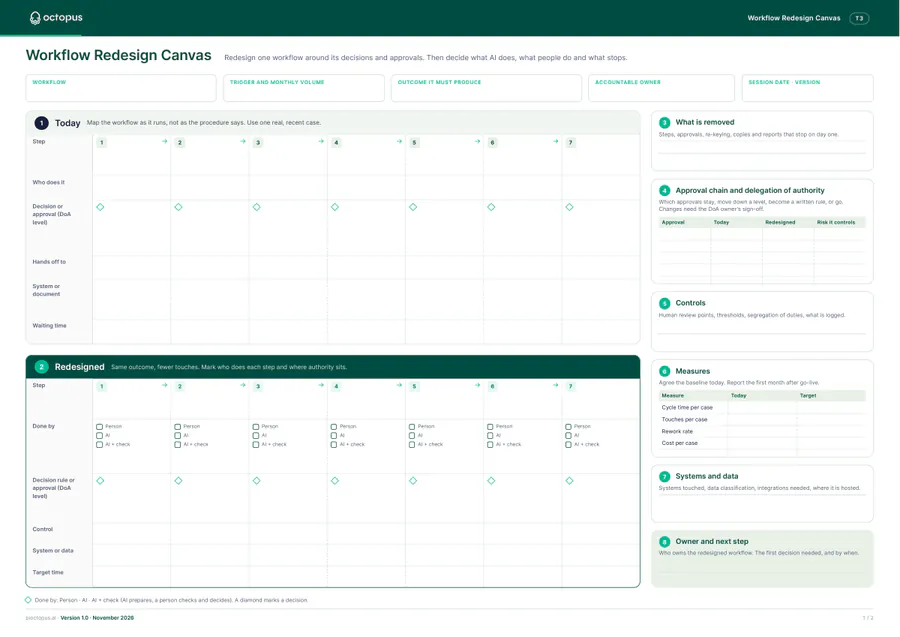
Once documents become data, the processes that depended on moving paper can be redesigned: a procurement approval, an expense claim, an HR request, an inspection report from the field. The next question is which steps still need a person at all, and which ones only existed to move a file from one desk to the next.
Paper is rarely the real problem. It is a sign that the process was never designed for data. Read the documents well, and the redesign can begin.
Document AI of this kind sits in our practice in operations and service re-engineering with AI, and the integration behind it in our digital core and ecosystem transformation practice.